
In a small behavioral-health practice not every clinician participates in every operational decision. An AI workflow that was designed and approved by the operations and administrative team may later need to be explained to a clinician who was not in the room. The quality of that explanation matters. A vague or defensive answer erodes trust. A clear, bounded explanation preserves it.
This article offers a practical structure for those conversations. The structure is designed for the reality of a five-to-fifteen-person clinic, where time is limited and the clinician’s primary concern is usually the effect on patient care and professional responsibility. The goal is not to persuade the clinician that the workflow is perfect. The goal is to make the design, the boundaries, and the ownership visible so that the clinician can form an informed view and raise any remaining concerns through a clear channel.
Start With What the Workflow Does Not Do
Clinicians are often most concerned about what an AI process might quietly change in clinical documentation or patient communication. Beginning with the boundaries reduces that concern faster than beginning with the benefits.
A useful opening follows this pattern:
The workflow processes only these specific non-clinical fields.
It never generates patient-facing language.
It never writes or suggests clinical content.
Every output is reviewed by a named administrative role before any further action.
The clinician’s own notes and clinical judgments remain entirely outside the process.
Stating the negatives first answers the questions the clinician is most likely carrying into the conversation. It also demonstrates that the design was intentional rather than opportunistic. When the first sentences make the limits visible, the rest of the conversation can focus on how the process works rather than on whether it has already overstepped.
We have observed that clinicians who hear the boundaries early are more willing to engage with the operational details. Those who first hear a list of efficiency benefits often remain focused on the potential clinical risks and have less attention left for the actual design.

Show the Decision Record, Not Just the Tool
A verbal description of the workflow is less persuasive than the written decision record that authorized it. Walking through the one-page record—scope, data boundaries, review owners, exception logging, and stop conditions—shows that the process was designed with accountability in mind. It also gives the clinician a document they can later reference if questions arise.
If the clinician raises a concern that the record does not address, the appropriate response is to note the gap and return to the decision process rather than to improvise an answer. That response signals that the practice treats the record as living rather than as a formality.
Address Professional Responsibility Directly
Clinicians carry professional and ethical obligations that administrative staff do not. An explanation that ignores those obligations will feel incomplete. The conversation should therefore include an explicit statement that clinical decision-making and patient-facing documentation remain under clinical control. The AI workflow does not alter that allocation of responsibility.
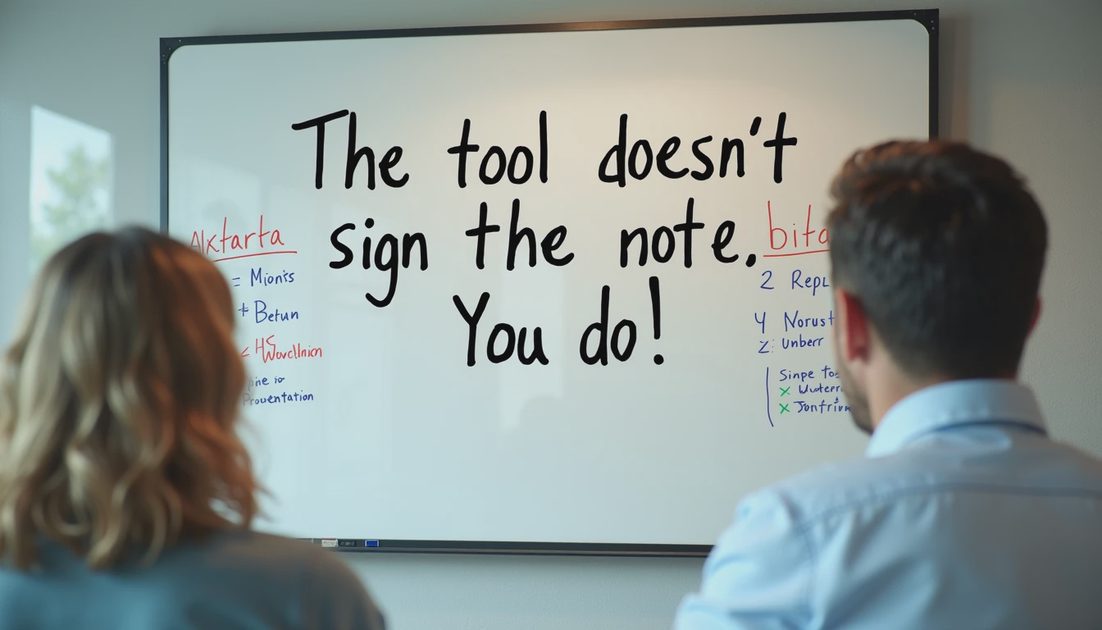
The phrase “the tool doesn’t sign the note” is useful here. It reminds both parties that the final professional act remains human and attributable. When that principle is visible in the design, clinicians are more likely to accept the administrative use of the tool even if they did not participate in the original approval.
Invite Questions Without Defensiveness
The most effective explanations end with a genuine invitation for questions and a clear path for raising later concerns. Defensive body language or rushed closure undermines the substance of the explanation. A short, calm conversation that leaves the door open is more durable than a polished presentation that leaves no room for doubt.
If the clinician’s questions reveal a design gap, the response is not to defend the existing process at all costs. The response is to treat the new information as input for possible revision. That stance converts a potential source of ongoing friction into a source of process improvement. It also models the same accountability the practice asks of its AI workflows: decisions are documented, boundaries are visible, and new information can change the design.
We have found that clinicians who receive a clear, non-defensive explanation are more likely to support the administrative use of the tool even if they remain cautious about broader applications. The explanation does not need to produce enthusiasm. It needs to produce understanding and a reliable channel for future questions.
That’s a judgment call, not a tool question. Explaining an AI workflow to a clinician who did not approve it is an act of operational transparency. Done well, it strengthens the practice’s ability to maintain trust across roles. Done poorly, it creates quiet resistance that later appears as non-compliance or informal workarounds. Slow is not the same as behind. Taking the time to prepare a clear, boundary-first explanation has consistently produced better long-term acceptance than any attempt to sell the benefits first.