
Every AI conversation in a small behavioral-health practice eventually reaches a fork. One path treats the issue as a tool question: which product has the right features, the right price, the right security language. The other path treats it as a judgment call: whether this particular use of technology belongs in the practice at all, under what boundaries, and with what human accountability. Confusing the two paths is one of the most common sources of later regret.
This article offers a practical way to tell the difference and to keep the judgment call visible even after a tool has been selected. The distinction is not academic. It determines whether the practice remains in control of its own operating decisions or slowly cedes that control to feature lists and vendor timelines.
Recognizing a Tool Question
A genuine tool question assumes the underlying decision has already been made. The practice has already decided that a specific administrative task will be supported by external processing. The remaining work is comparative: data retention terms, access controls, integration effort, and cost. These questions are important. They are also secondary.
Examples of true tool questions include:
Does this vendor’s retention schedule match our internal policy?
Can we restrict the tool to non-clinical fields only?
What is the process for deleting data if we end the relationship?
These questions have factual answers. They can be researched, compared, and documented. They do not, by themselves, decide whether the practice should proceed.

Recognizing a Judgment Call
A judgment call appears when the practice is still deciding whether the proposed use belongs inside its walls. Typical signals include:
The use case is described in broad language (“help with notes,” “speed up intake”)
Different staff members hold different assumptions about risk tolerance
No one can yet name the exact data that will leave the environment
The human review step is still being designed rather than already scheduled
When these signals are present, shopping for tools is premature. The prior work is to clarify scope, name owners, and decide whether “not yet” is the responsible answer. That work is a judgment call. It cannot be outsourced to a vendor’s marketing page or a feature comparison chart.
In our practice the first AI proposal was treated as a tool question. We spent weeks evaluating platforms before legal review asked the more basic questions about data minimization and ownership. The project had to restart from the judgment layer. The restart cost time. It also prevented us from building something we could not later defend.
Questions That Force the Distinction
When a new AI idea surfaces, we now ask three clarifying questions before any demo is scheduled:
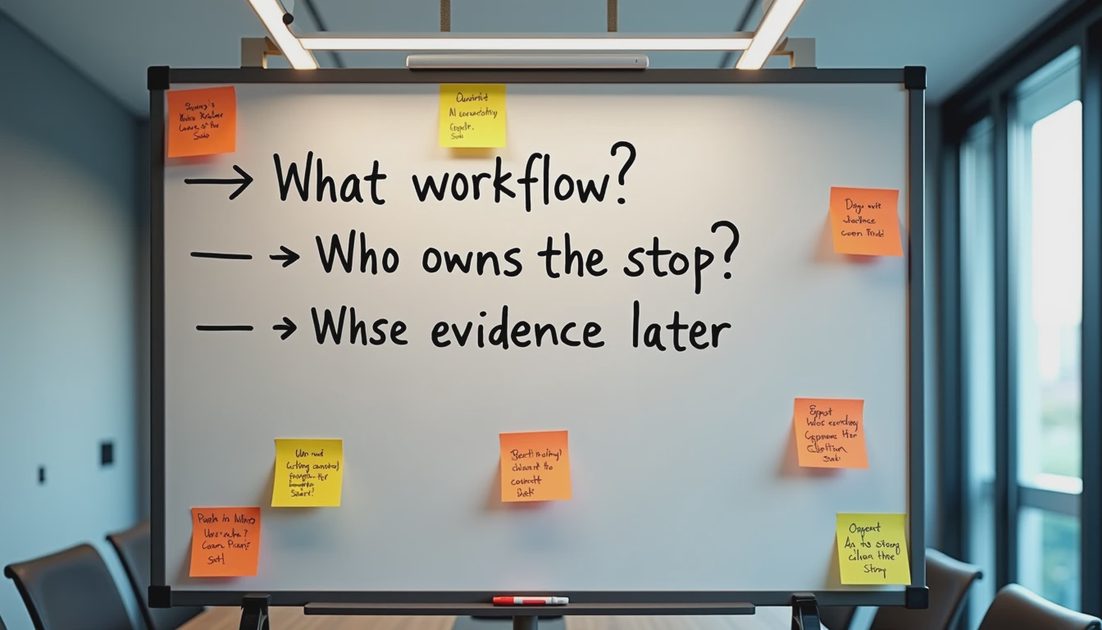
What exact workflow is under consideration, and what is explicitly out of scope?
Who will own the decision to approve, pause, or stop the workflow?
What evidence will we need six months from now to explain why we proceeded?
If the answers are vague, the conversation is still at the judgment stage. Tool evaluation waits until the answers are written down and shared.
Keeping the Judgment Visible After Selection
Even after a tool is chosen, the original judgment call needs to remain accessible. Feature updates, staff turnover, and quiet scope expansion can erode the boundaries that made the decision defensible. The practical safeguard is the one-page decision record described elsewhere on this site. That record captures the judgment at the moment it was made and keeps it available when conditions change.
We also treat any significant change in the tool’s capabilities or our own data practices as a trigger to revisit the original judgment. New features are not automatically approved simply because the vendor added them. Each expansion returns to the same three questions.
The Cost of Treating Judgment as a Tool Problem
When practices reverse the order—selecting a tool first and clarifying judgment later—they often discover the mismatch only after staff have been trained and patients have been affected. Correction then requires both technical rollback and relational repair. The second cost is usually higher than the first.
Keeping the distinction clear does not mean refusing every new tool. It means refusing to let tool evaluation substitute for the harder work of deciding what the practice is willing to own. The tool doesn’t sign the note. You do. That sentence is a judgment statement, not a product specification.
That’s a judgment call, not a tool question. Learning to recognize which kind of conversation is underway is one of the most useful skills a small-practice leader can develop. It keeps the practice in control of its own pace and its own accountability.
Slow is not the same as behind. Taking the time to settle the judgment before shopping for tools has consistently produced cleaner, more durable decisions in our experience.